PARENT EDUCATION · PHYSICIAN-REVIEWED · SCARSDALE NY
HBOT + AUTISM.
THE STRAIGHT ANSWER.
If you're a parent researching hyperbaric oxygen therapy for your child, you've probably seen bold claims online. Here's a plain-language summary from a physician-owned practice — including the studies that don't flatter the sale.
01 · THE HYPOTHESIS
WHY PARENTS
EXPLORE HBOT.
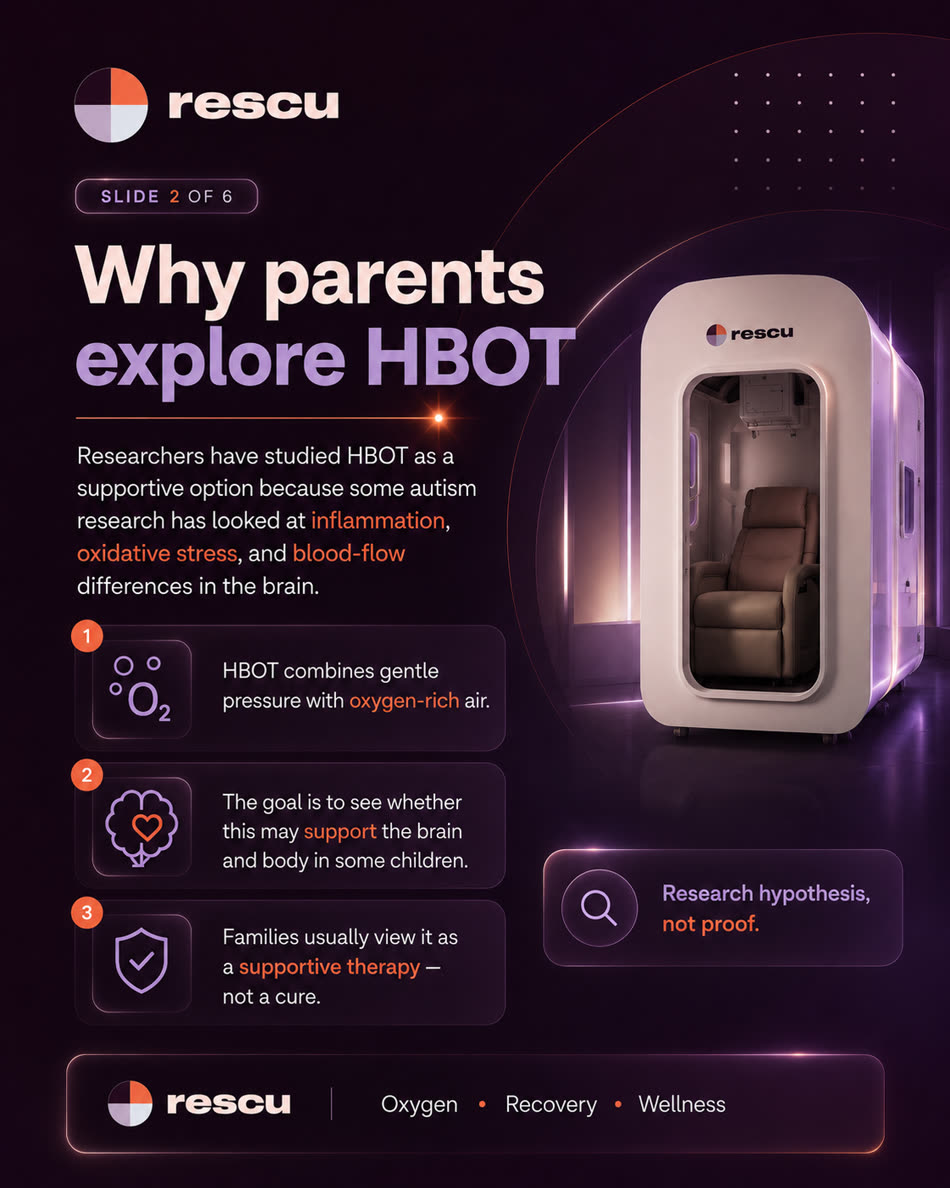
Researchers have studied HBOT as a possible supportive option because some autism research has looked at inflammation, oxidative stress, and cerebral blood-flow differences in some children. HBOT delivers oxygen-rich air under gentle pressure, and the scientific question has been whether that may support brain and body function in a subset of children.
Two words matter here: research hypothesis. This is a question scientists have investigated — not a proven mechanism, and not a cure. Families who explore it generally frame it as a possible supportive therapy alongside a child's established care, never in place of it.
02 · WHAT THE STUDIES USED
WHAT HBOT
INVOLVES.
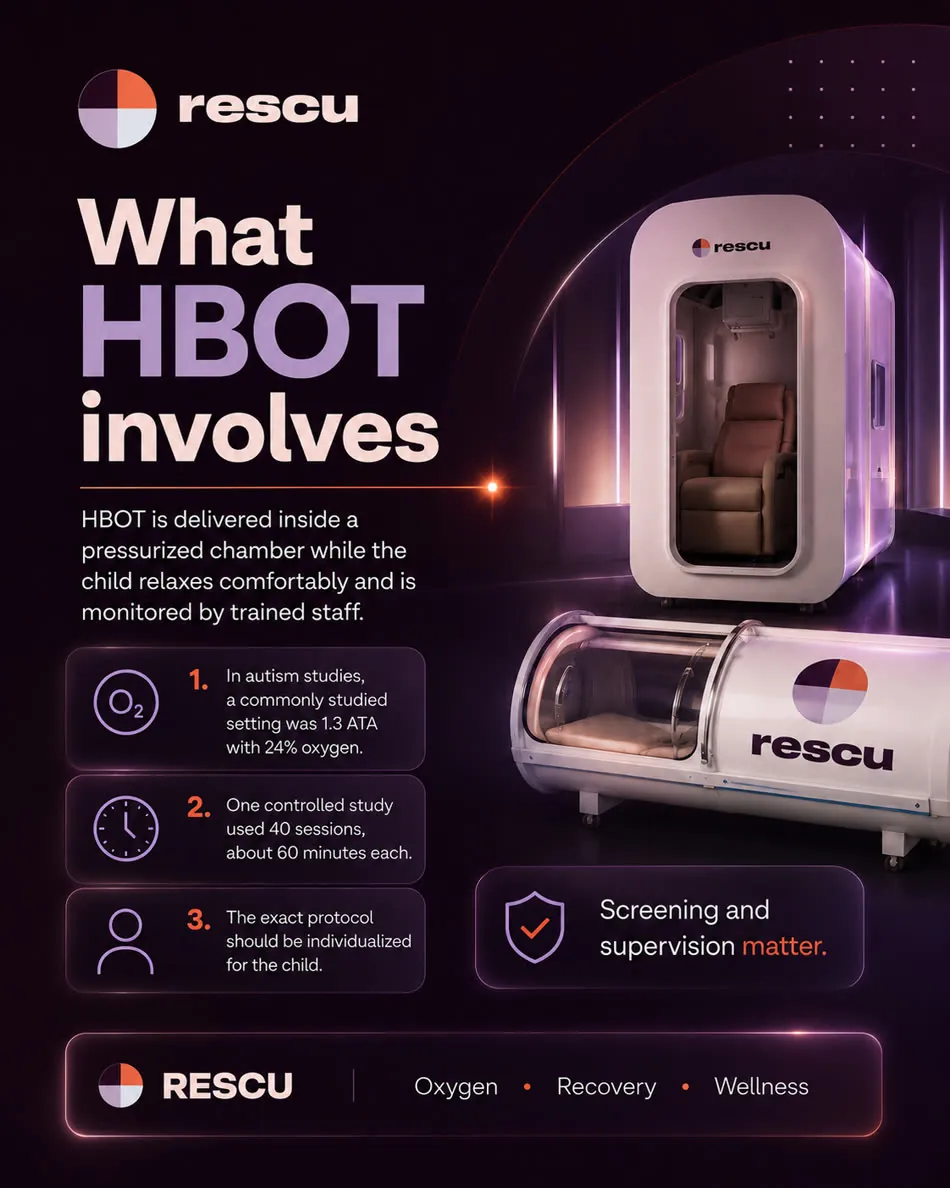
In the published autism studies, HBOT was typically delivered at a mild pressure of 1.3 ATA with 24% oxygen — noticeably gentler than the pressures used for FDA-cleared medical indications. The most-cited controlled trial used 40 sessions of about 60 minutes each, with the child relaxing inside the chamber while monitored by trained staff.
Those are study parameters, not a menu item. If HBOT were ever considered for a specific child, the approach would need to be individualized by a physician after screening — which is exactly why this page ends at a consult, not a checkout.
03 · THE ENCOURAGING SIGNAL
WHAT SOME
STUDIES FOUND.
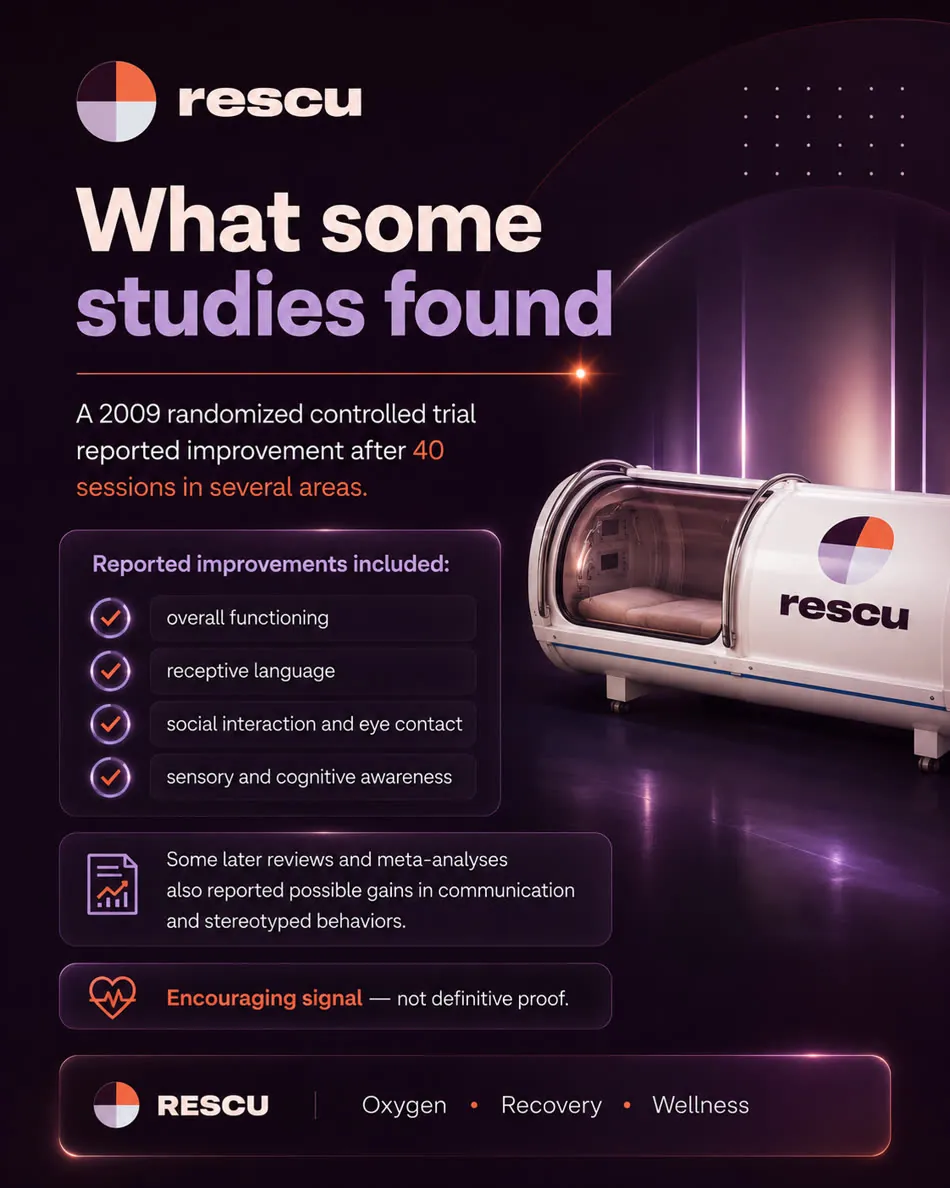
A 2009 multicenter, randomized, controlled trial (Rossignol et al.) reported improvements after 40 sessions in areas including overall functioning, receptive language, social interaction and eye contact, and sensory awareness. Some later reviews and pooled analyses — including a 2025 meta-analysis of 17 studies — have also reported possible gains in communication and behavior.
04 · THE FULL PICTURE
THE BIG
REALITY CHECK.
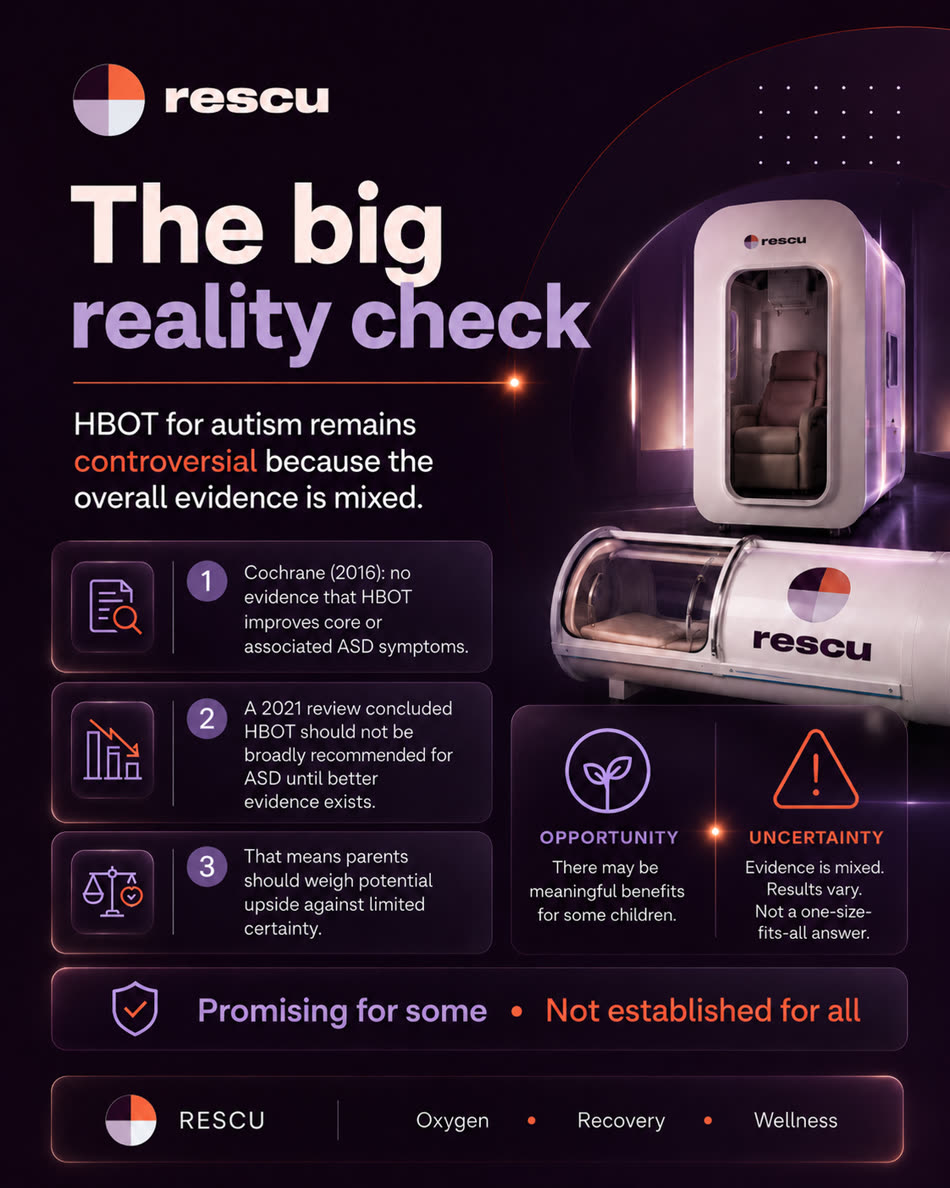
Here is the part many clinics skip. Cochrane's 2016 systematic review — medicine's most demanding standard of evidence synthesis — found no evidence that HBOT improves core or associated symptoms of ASD. A separate 2016 evidence-based review reached the same conclusion, and a 2012 review of the randomized trials noted that the promising early effects were not replicated.
The FDA has not cleared HBOT for autism, and has publicly cautioned families about clinics marketing hyperbaric therapy for conditions where it is unproven. Mainstream autism-care guidelines do not recommend it. That means parents should weigh any potential upside against real cost, real time, and genuine scientific uncertainty.
05 · IF YOU'RE STILL CONSIDERING IT
SAFETY +
SCREENING.
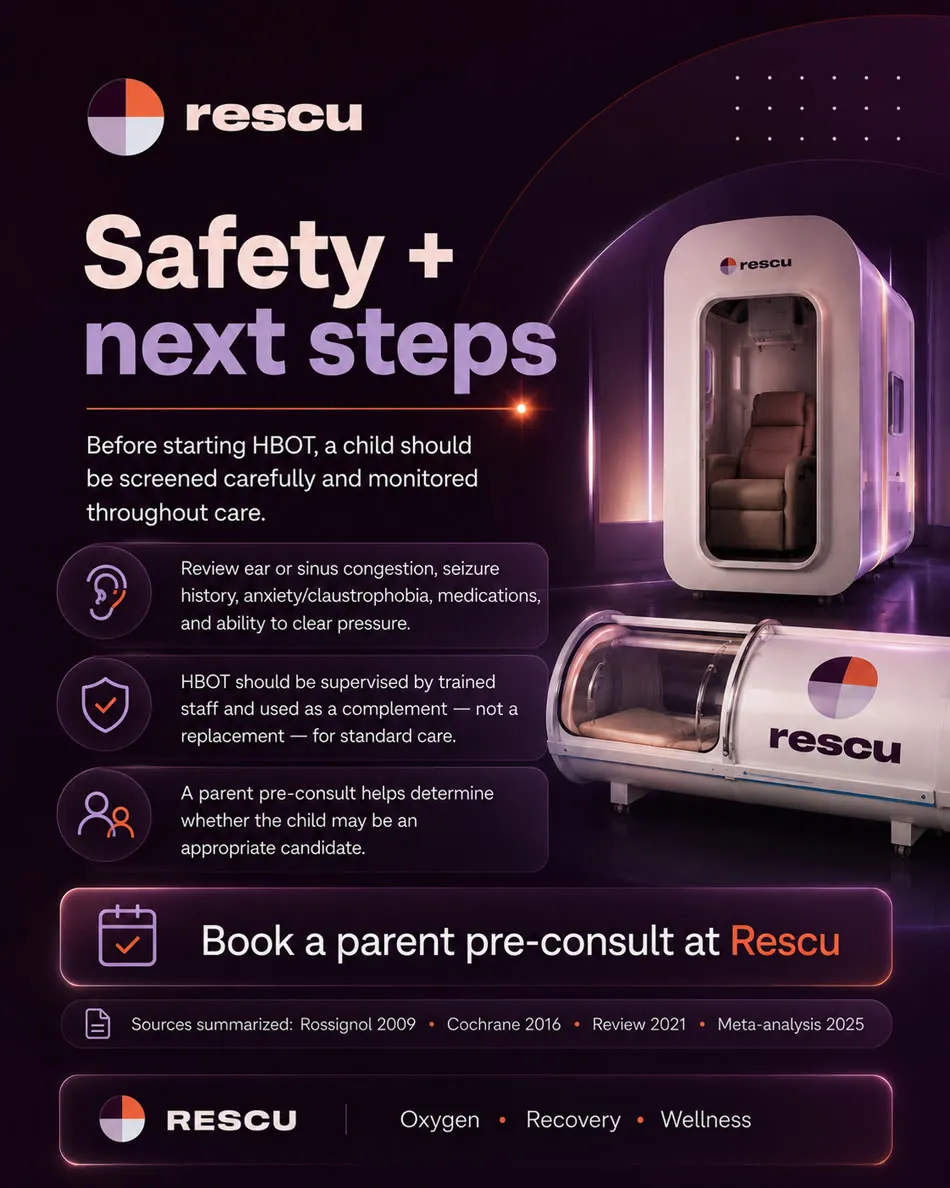
At the mild pressures used in the studies, supervised HBOT is generally well tolerated — but "generally" is doing work in that sentence, and children are not small adults. Before any session would ever be considered, a physician needs to screen carefully:
WHERE RESCU STANDS
A CONVERSATION.
NOT A CHECKOUT.
We do not market HBOT as a treatment for autism, and we won't sell you forty dives on hope. If, after reading all of this, you're still weighing HBOT for your child, the right first step is a parent pre-consult with Dr. Taylor — a board-certified emergency physician and the owner of this practice.
He'll review your child's health history and current therapies, walk through the evidence honestly, screen for the safety considerations above, and give you a straight answer about whether your child would even be an appropriate candidate. Sometimes that answer is no — and you'll hear it plainly before anyone books anything.
EDUCATIONAL CONTENT · NOT MEDICAL ADVICE · HBOT IS NOT FDA-CLEARED FOR AUTISM · NOT INTENDED TO DIAGNOSE, TREAT, CURE, OR PREVENT ANY DISEASE
RESCU/FAQ · PARENTS' QUESTIONS, ANSWERED STRAIGHT
What parents ask.
Is HBOT an FDA-approved treatment for autism?
Does HBOT cure autism?
What does the research actually show?
Is HBOT safe for children?
What happens at a parent pre-consult?
Sources & further reading
- Rossignol DA, et al. Hyperbaric treatment for children with autism: a multicenter, randomized, double-blind, controlled trial. BMC Pediatrics. 2009.
- Granpeesheh D, et al. Randomized trial of hyperbaric oxygen therapy for children with autism. Research in Autism Spectrum Disorders. 2010.
- Ghanizadeh A. Hyperbaric oxygen therapy for treatment of children with autism: a systematic review of randomized trials. Medical Gas Research. 2012.
- Xiong T, et al. Hyperbaric oxygen therapy for people with autism spectrum disorder (ASD). Cochrane Database of Systematic Reviews. 2016.
- Goldfarb C, et al. Hyperbaric oxygen therapy for the treatment of children and youth with Autism Spectrum Disorders: an evidence-based systematic review. Research in Autism Spectrum Disorders. 2016.
- Systematic review and meta-analysis of HBOT in children and adolescents with autism spectrum disorders (17 studies, 890 patients). Progress in Neuro-Psychopharmacology & Biological Psychiatry. 2025.
- U.S. Food & Drug Administration. Hyperbaric Oxygen Therapy: Get the Facts. FDA Consumer Update.