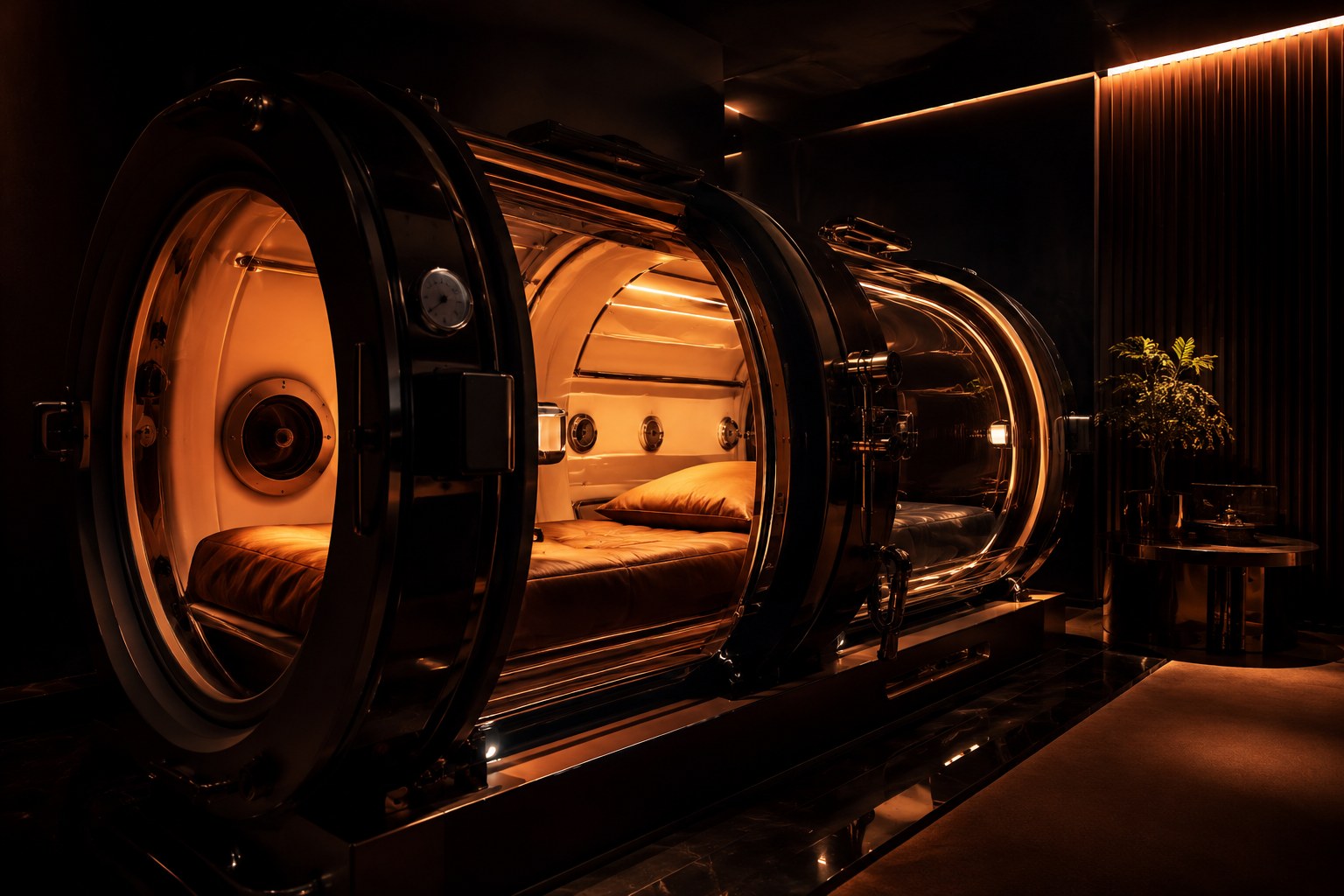
Walk into almost any high-end gym or wellness center now and you'll find a hyperbaric chamber in the corner. Elite athletes swear by them. Longevity influencers film themselves inside them. The question worth asking before you book a session — or a package — is a simpler one: what is actually happening in there, and how much of it depends on the machine you choose?
The physiology, in plain terms
Normally, the oxygen you breathe is carried almost entirely by hemoglobin in your red blood cells, which run close to fully saturated. You can't force much more in by breathing harder. Hyperbaric oxygen therapy changes the equation by changing the pressure: inside a pressurized chamber breathing concentrated oxygen, the gas dissolves directly into your blood plasma — the fluid itself — reaching tissue that struggling circulation can't easily supply.
More dissolved oxygen, delivered under pressure, is the mechanism behind HBOT's established and studied effects: supporting wound healing, reducing swelling, and aiding tissue repair. For recovery-minded users, that translates into the appeal: helping the body do its repair work more efficiently between hard efforts.
Under pressure, oxygen dissolves directly into blood plasma — reaching tissue that normal circulation struggles to supply. That's the entire premise of HBOT.
Why athletes use it for recovery
Hard training is, at the cellular level, controlled damage — micro-tears, inflammation, depleted tissue that the body then rebuilds stronger. The faster and more completely that rebuild happens, the sooner you can train hard again. The recovery case for HBOT rests on oxygen's role in that repair process: more oxygen reaching stressed tissue, supporting the work of clearing inflammation and rebuilding.
This is why HBOT has moved from hospital wound-care units into the recovery routines of professional and serious amateur athletes — the same logic that put it in our piece on HBOT for athletes. It's not a substitute for sleep, nutrition, or smart programming; it's a tool that supports the recovery those fundamentals drive. Individual results vary, and HBOT is not intended to diagnose, treat, cure, or prevent any disease.
The thing nobody tells you: the chamber matters enormously
Here is where most first-time users get misled. Not all hyperbaric chambers are the same, and the difference isn't cosmetic — it's physics.
- Soft chambers are inflatable, and by design they're limited to roughly 1.3 atmospheres (ATA), typically with ambient air. They're gentler, more portable, and lower-cost — and they offer a real, if modest, effect.
- Hard chambers are rigid, medical-grade units that reach 1.5 ATA or higher and deliver concentrated oxygen. This is the pressure-and-oxygen combination that most of the clinical hyperbaric literature is actually based on.
The catch: a soft chamber and a hard chamber can be marketed with nearly identical language — both called "hyperbaric oxygen therapy." A consumer comparing them on a website often can't tell which they're being sold. If you're paying for medical-grade results, the chamber type is the first thing to confirm.
Soft chamber (~1.3 ATA, ambient air) vs. hard chamber (1.5 ATA+, concentrated oxygen). Both get called 'HBOT' — but the clinical research is based on hard chambers. Always confirm which you're paying for.
How many sessions, and what to expect
HBOT works cumulatively. A single session can be a worthwhile introduction, but the effects build over a series — a common working range starts at a minimum of around ten dives and compounds toward forty over roughly eight to fourteen weeks, depending on your goal. Each session typically runs 60–90 minutes; you'll feel pressure in your ears like a descending airplane, and in a vertical chamber you can read, work, or take calls throughout.
The more important variable than session count is whether someone is matching the protocol to you. Pressure, duration, and dive count should reflect your specific goal — athletic recovery, longevity, fatigue, post-effort repair — not a one-size template. That's a clinical decision, which is why who is running the program matters as much as the equipment.
Getting it right: equipment plus oversight
Good HBOT comes down to two things: a real hard chamber, and a physician who programs it to your goal. At Rescu, hard-chamber HBOT is owned and supervised by Dr. Randy Taylor, a board-certified emergency physician, who maps your protocol before your first dive — and can fold it into a wider recovery or longevity plan rather than selling it as an isolated session. For full pricing and the soft-versus-hard breakdown, see our HBOT cost guide, and if you're comparing local providers, our honest provider comparison.
The bottom line
Hyperbaric oxygen is a genuinely useful recovery and longevity tool, grounded in real physiology: pressure drives oxygen into plasma and into tissue that needs it. But the benefit you get is only as good as the chamber you sit in and the physician programming it. Confirm it's a hard chamber, confirm there's a doctor behind the protocol, and HBOT earns its place in a serious recovery routine.
HBOT mechanism (dissolved plasma oxygen under pressure) and established uses per standard hyperbaric medicine references. Soft- vs hard-chamber pressure distinctions per device classifications (soft chambers ~1.3 ATA; medical hard chambers 1.5 ATA+). Session-protocol ranges reflect general clinical practice and vary by indication. This article is informational and not a substitute for individualized medical advice. Individual results vary. HBOT is not intended to diagnose, treat, cure, or prevent any disease.